
Books
Forgotten Values: The World Bank
and Environmental Partnerships

Multi-stakeholder partnerships have become an increasingly common form of global governance. Partnerships, usually between international organizations (IOs) or state agencies and such private actors as NGOs, businesses, and academic institutions, have even been promoted as the gold standard of good governance—participatory, innovative, and well-funded. And yet these partnerships often fail to live up to the values that motivated their establishment. In this book, Teresa Kramarz examines this gap between promise and performance by analyzing partnerships in biodiversity conservation initiatives launched by the World Bank.
Kramarz reviews World Bank biodiversity partnerships over a twenty-year period, with in-depth studies of two: the Critical Ecosystem Partnership Fund and the Global Invasive Species Program. She finds that partnerships fall short when established in the shadow of a large, mature bureaucracy. Bureaucrats have trouble relinquishing control, and they distrust partners who do not abide by set policies and procedures. The partnership's potential contribution to biodiversity conservation succumbs to the goals of bureaucratic efficiency. Kramarz develops a theoretical framework to explain the gap between values and practice, combining rationalist and constructivist approaches. Viewing World Bank biodiversity partnerships through this theoretical lens, she shows how the World Bank's risk aversion, hierarchy, focus on rules and procedures, and division of labor have a significant influence on partnership outcomes.
Populist Moments and Extractivist States
in Venezuela and Ecuador: The People’s Oil?

This book addresses the intersection of extractivism, populism, and accountability. Although populist politics are often portrayed as a driver of poor environmental governance, Populist Moments and Extractivist States identifies it as an intervening variable at best – one that emerges in response to the accountability deficits of extractive states. Case studies in Venezuela – for many, the prototypical petrostate – and Ecuador – which exchanged agribusiness dependency for oil decades later – illustrate how extractive states are oriented by a colonial logic of export and service. This logic regulates state-society-nature relationships and circumscribes avenues for local stakeholders to hold public officials and extractive industries to account for environmental and human harms. Populist moments of the early 21st century across Latin America responded to these conditions, promising more equitable and sustainable futures. However, rather than reversing the technocracy, verticalism, and exclusion of the recent past, populist moments often intensified and legitimated them in the drive to maximize and distribute resource rents. The result has been cyclical, as populist moments of hope and rupture fall prey to the extractivist states they tried, and failed, to replace.
Global Environmental Governance
and the Accountability Trap

The rapid development of global environmental governance has been accompanied by questions of accountability. Efforts to address what has been called “a culture of unaccountability” include greater transparency, public justification for governance decisions, and the establishment of monitoring and enforcement procedures. And yet, as this volume shows, these can lead to an “accountability trap”—a focus on accountability measures rather than improved environmental outcomes. Through analyses and case studies, the contributors consider how accountability is being used within global environmental governance and if the proliferation of accountability tools enables governance to better address global environmental deterioration. Examining public, private, voluntary, and hybrid types of global environmental governance, the volume shows that the different governance goals of the various actors shape the accompanying accountability processes. These goals—from serving constituents to reaping economic benefits—determine to whom and for what the actors must account.
After laying out a theoretical framework for its analyses, the book addresses governance in the key areas of climate change, biodiversity, fisheries, and trade and global value chains. The contributors find that normative biases shape accountability processes, and they explore the potential of feedback mechanisms between institutions and accountability rules for enabling better governance and better environmental outcomes.
Contributors Graeme Auld, Harro van Asselt, Cristina Balboa, Lieke Brouwer, Lorraine Elliott, Lars H. Gulbrandsen, Aarti Gupta, Teresa Kramarz, Susan Park, Philipp Pattberg, William H. Schaedla, Hamish van der Ven, Oscar Widerberg
Special Issues Editor
Kramarz, Teresa and Susan Park (2017). “Accountability, Policy and Environmental Governance,” Special Issue Editors of Review of Policy Research, 34 (1).
Park, Susan and Teresa Kramarz (2016). “Accountability in Global Environmental Governance,” Special Section editors of Global Environmental Politics 16 (2).
Journal Articles


Gujral, Harshit, Om Damani, Anshul Agarwal, Christoph Becker, Meredith Franklin, Teresa Kramarz, Ronak Sutaria, Sagnik Dey, Steve Easterbrook (2025) “Reimagining Urban Air-Quality Governance: A Systems-Thinking Framework.” Science of the Total Environment.
Winter, Jacob, Ben Cormier, Teresa Kramarz and Mark Manger (2025) “Reassessing World Bank Conditionality: Beyond Count Measures." Political Science Research and Methods.
Johnson, Craig, Susan Park and Teresa Kramarz (2025) “The Unbearable Lightness of Critical Minerals Governance: Legitimizing Extraction for a ‘Just’ Energy Transition.” Earth System Governance, 25.
Park, Susan, Teresa Kramarz and Craig Johnson (2024) “Governance Gaps and Accountability Traps in Renewables Extractivism” Environmental Policy and Governance, 34
Kramarz, Teresa, Maria Victoria Arias, Tomas Allan, Melisa Escosteguy, Donald Kingsbury and Lucas Seghezzo (2024) “Redundancies, Layers, and Dilemmas: Comparing Private Standards and Public Regulations in Lithium Mining” The Extractive Industries and Society, 18
Johnson, Craig, Teresa Kramarz, Matthew McBurney and Yojana Miraya Oscco (2023) “Accumulation through Destabilization: Manufacturing Indigenous Consent for Industrial Mining in Latin America” Journal of Peasant Studies.
Mason, Michael, Lena Partzsch and Teresa Kramarz (2023) “The Devil is in the Detail: The Need for a Decolonizing Turn and Better Accountability in Global Supply Chain Regulations: A Comment” Regulation and Governance, 17
Kramarz, Teresa, and Donald Kingsbury (2022), “Climate Action and Populism of the Left in Ecuador.” Environmental Politics, 31 (5).
Kramarz, Teresa, Michael Mason, Lena Partzsch (2022), “Proxy-led Accountability for Natural Resource Extraction in Rentier States.” Environmental Politics, 32 (1).
Kramarz, Teresa (2021), “Extractive Industry Disasters and Community Responses: A Typology of Vulnerable Subjects.” Environmental Politics 31 (1).
Kramarz, Teresa, Susan Park and Craig Johnson (2021), “Governing the Dark Side of Renewable Energy: A Typology of Global Displacements.” Energy Research in the Social Sciences, 74
Park, Susan, Teresa Kramarz, Craig Johnson and Stacy VanDeveer (2019), “Globalizing the Global Green New Deal: Harmful Extractives in the Green Energy Shift,” in The Green New Deal: Pathways to a Low Carbon Economy. Public Administration Review Bully Pulpit Symposium.
Kingsbury, Donald, Teresa Kramarz, and Kyle Jacques (2019). “Populism or Petrostate? The Afterlives of Ecuador’s Yasuní-ITT Initiative.” Society and Natural Resources, 32 (5).
Kramarz, Teresa (2018). “Using the Courts to Protect the Environment in Argentina: Accountability Pitfalls When Judges Have the Last Word.” Case Studies in the Environment, 2 (1).
Kramarz, Teresa, and Susan Park (2017). “The Politics of Environmental Accountability.” Review of Policy Research, 34 (1).
Kramarz, Teresa, David Cosolo and Alejandro Rossi (2017). “The Judicialization of Environmental Policy and the Decline of Democratic Accountability.” Review of Policy Research, 34 (1).
Kramarz, Teresa, and Susan Park (2016). “Accountability in Global Environmental Governance: A Meaningful Tool for Action?” Global Environmental Politics, 16 (2).
Kramarz, Teresa (2015). “World Bank Partnerships and the Promise of Democratic Governance.” Environmental Policy and Governance, 26 (1).
Kramarz, Teresa and Bessma Momani (2013). “The World Bank as Knowledge Bank: Analyzing the Limits of a Legitimate Global Knowledge Actor.” Review of Policy Research, 30 (4)
Kramarz, Teresa (2008). “International Organizations and Public-Private Partnerships for Biodiversity Conservation: From Policy Entrepreneurs to Norm Entrepreneurs?” In Global Tensions Global Possibilities: Everyday Forces of Conformity and Contestation. Institute on Globalization and the Human Condition, Globalization Working Paper Series, 8 (2).
Student co-authors underlined
Book Chapters


Kramarz, Teresa and Amalie Wilkinson (2024). “Environmental Partnerships in the World Bank,” in The Elgar Companion to the World Bank. Antje Vetterlein and Tobias Schmidtke eds. Edward Elgar Publishing, 191-204.
Kramarz, Teresa (2023) “Extractive industry disasters and community responses: a typology of vulnerable subjects,” in The Politics of 21st Century Environmental Disasters, edited by Susan Park. New York: Routledge. (Reprint)
Agrawal, Atharv, Jonathan Banfield, Suehyun Cho, Teresa Kramarz and Eric Zhao (2021) “Community Vulnerability to Extractive Industry Disasters,” in The Palgrave Encyclopedia of Urban and Regional Futures, edited by Robert Brears. London: Palgrave Macmillan
Kramarz, Teresa (2020) “Broad and Deep Transformations,” in Towards a Just Ecological Transition in the European Union, edited by César Luena and Antonio Estella. Madrid: Catarata.
Kramarz, Teresa, and Susan Park (2019) “Identifying Multiple Accountabilities in Global Environmental Governance,” in Global Environmental Governance and the Accountability Trap, edited by Susan Park and Teresa Kramarz. Boston: MIT Press
Park, Susan, and Teresa Kramarz. (2019) “Does Accountability Matter for Global Environmental Governance?” in Global Environmental Governance and the Accountability Trap, edited by Susan Park and Teresa Kramarz. Boston: MIT Press
Kramarz, Teresa and Bessma Momani (2018) “Knowledge and Learning in the World Bank: Assessing the Role, Challenges and Prospects for a More Accountable IFI,” in John Kirton and Marina Larionova (editors), Accountability for Effectiveness in Global Summit Governance, Global Governance Series. Aldershot, England: Ashgate Publishing.
Kramarz, Teresa (2012). “Partnerships in Global Environmental Governance: The Growth of a Procedural Norm without Substance” in Roldan Muradian and Laura Rival (editors), Governing the Provision of Ecosystem Services. New York: Springer.
Student co-authors underlined
Climate Magazine:
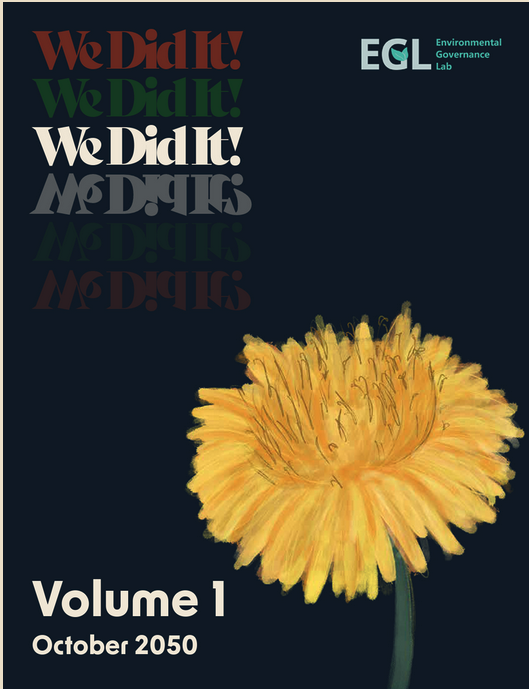
We Did It !?
Hoffmann, Matthew, Steven Bernstein, Teresa Kramarz, eds. “We Did It!? A Future History of Net Zero in Canada.” Volumes 1 and 2. Environmental Governance Lab, University of Toronto. Available at https://wedidit2050.ca
Kramarz, Teresa (2023), “Thirsty,” in We Did It!? A Future History of Net Zero in Canada, Hoffmann, Matthew, Steven Bernstein, Teresa Kramarz, eds. Environmental Governance Lab, University of Toronto. Volume 1, 20-23. Available at https://wedidit2050.ca
Non-Refereed Reports:
Arias Mahiques, Victoria, Allan, Tomas, Escosteguy, Melisa, Kramarz, Teresa, and Kingsbury, Donald (2024). “Convergence, Divergence or Mixed-Results? A comparison Between Private and Public Rules Governing Lithium Mining in Argentina.” Fundar, Argentina. Available at https://fund.ar/wp-content/uploads/2024/06/Fundar_Convergence-divergence-or-mixed-results_A-comparison-between-private-and-public-rules-governing-lithium-mining-in-Argentina-1.pdf (Accessed July 4, 2024)
Kramarz, Teresa (2022). “The Renewable Energy Transition has an Extractivism Problem.” World Politics Review. November 15. Available at: https://www.worldpoliticsreview.com/environmental-impact-mining-extractivism-green-energy-transition/. (Accessed November 20, 2022]
Kramarz, Teresa (2019). “Curricular Review of Global Politics.” Report for the International Baccalaureate Organization. The Hague, Netherlands.
Kramarz, Teresa (2017). “Internationalizing the Domestic Curriculum: Global Classrooms at the University of Toronto.” Teaching Fellowship Report, University of Toronto.
Kramarz, Teresa and Jeff Burrows (2014). “Woodsworth One: Assessment of a First-Year Program’s Impact on Academic Engagement.” Program Evaluation for Woodsworth College, Faculty of Arts and Science, University of Toronto.
Kramarz, Teresa, Ben Donato-Woodger, and Kristen Pue (2014). “Accountability in Global Environmental Governance.” Workshop Report. Toronto, Canada: University of Toronto. Available at: http://www.earthsystemgovernance.org/publication/kramarz-teresa-accountability-global-environmental-governance. [Accessed: 9 June 2014].
Recent Invited Lectures
“What’s the Problem with Critical Minerals for the Energy Transition?” Keynote Hammond Lecture, University of Guelph, October 24, 2025 (forthcoming)
“Energy Policy and Environmental Issues: Latin America, Critical Minerals and the Energy Transition,” United States Department of State, Foreign Service Institute, Arlington Virginia, May 27, 2025
“Storylines and Narratives in the Transition to Renewable Energy,” Keynote Speaker for the Conference on Energy Humanities and the South: Energy Justice in a Period of Transition. Texas A&M University, October 11, 2024
“Governing the Dark Side of Renewable Energy,” United States Department of State, Foreign Service Institute, Arlington Virginia, August 27, 2024 and February 4, 2025
“Dilemmas of Sustainability: Green Energy Transition and Extractivism in the Global South,” Special Lecture, University of Marburg, Germany, July 10, 2024
“Javier Milei and Argentina’s Collapse” Extractivism Talks, University of Kassel, Germany, July 8, 2024.
“What if We Get This Transition Right?” The Transition Accelerator, panel presentation, Transition Accelerator, online. April 22, 2024
“Energy Disasters and Vulnerable Communities” Public Lecture of the Urban Water Seminar Series, Toronto Metropolitan University, February 13, 2024
“University of Toronto Where You Are: Can Electric Vehicles Save the Planet?” panel presentation, University of Toronto Global Advancement, Delta Hotel, Toronto. November 29, 2023
“Violence And Friction on the Extractive Frontier: Community Responses to Industrial Mining in Ecuador and Perú,” presentation at the School of Environment, University of Toronto. February 13, 2023.
“Critical Minerals Supply Chains: Transnational Standards and Regulations” presentation at the University of San Martin, Buenos Aires, Argentina. October 22, 2022
Invited speaker in the Workshop “Rare Earths in the Just Transition: Connecting Global Inequalities in REE Commodity Chains.” September 14, 2022
“Transitions to Renewable Energy,” presentation at the Business School of the University of San Martin, Argentina. September 9, 2022
“Governing the Dark Side of Renewable Energy: From Global Displacements to Accountability for a Sustainable Transition,” presentation at the School of the Environment, University of Toronto. April 11, 2022.
Commentator of David Miller’s new book “Solved: How the World’s Great Cities are Fixing the Climate Crisis,” School of Cities and Environmental Governance Lab. November 25, 2020. Available here https://youtu.be/BWwtyLl0PKw
Commentator of “What does a just transition look like in a time of pandemic?” Environmental Governance Lab. November 24, 2020. Available here: https://youtu.be/QMEBeW9A_Fo
“Book Launch: Forgotten Values: The World Bank and Environmental Partnerships,” Munk School of Global Affairs and Public Policy. October 27, 2020. Available at: https://youtu.be/fICeMUIUeMs
“Climate Change and Communities: Lessons from Some of the World’s Most Vulnerable.” Presentation at American University Center for Environmental Policy. November 4, 2020 Available at https://youtu.be/L5k2a2yNfnQ
Expert witness, European Parliament hearing on the future EU-UK relationship. Brussels, Belgium. October 12, 2020
“Global Classrooms,” Presenter at the Center for International Experience, University of Toronto. July 28, 2020.
“Forgotten Values: The World Bank and Environmental Partnerships” Institut Barcelona Estudis Internacionals, Barcelona, Spain. July 6, 2020. Available at https://youtu.be/C8vU66ODfm4
“The World Bank, Bureaucratic Rationality and the Promise of Environmental Partnerships,” Presentation to the Permanent Seminar, Carlos III-Juan March Institute, Madrid, Spain. March 6, 2020
“Towards a Fair Ecological Transition in the European Union,” Keynote Speaker, European Parliament, Progressive Alliance of Socialists and Democrats, Madrid. November 15, 2019
Recent Conference Papers and Workshops
2024 - Paper This Time it will be Different: Derisking Development in the South American Lithium Triangle, Comparing Extractivist Regimes: Natural Resources in the Global Path Towards Sustainability. Extractivism International Conference, University of Kassel, Germany
2024 - Global Commons Working Group Member on Critical Minerals, Institute for the Study of Diplomacy Working Group, Georgetown University, Washington DC
2024 - ISA-CPSA Presidential Roundtable Presentation on Critical Mineral’s Governance Challenges, International Studies Association Annual Conference, San Francisco, USA
2024 - Paper Redundancies, Complementarities, and Dilemmas: Private Standards and Public Rules for Mining Lithium in Argentina, International Studies Association Annual Conference, San Francisco, USA
2024 - Paper The Unbearable Lightness of Critical Minerals Governance International Studies Association Annual Conference, San Francisco, USA
2024 - Paper Energy Disasters and the Construction of Vulnerable Subjects, International Studies Association Annual Conference, San Francisco, USA
2023-24 - Annual Working Group Member Uncertain Worlds: Comparative Perspectives on Risk, Jackman Humanities Institute, University of Toronto, Canada
2023 - Roundtable presentation Critical Minerals, Green Technology, and Climate Change, International Studies Association Annual Conference, Montreal, Canada.
2023 - Paper Violence and Friction on the Extractive Frontier: Community Responses to Industrial Mining in Ecuador and Peru, Earth Systems Governance Conference, Toronto (with Craig Johnson)
2021 - Paper Governance Gaps and Accountability Traps in the Global Shift to Renewable Energy, International Studies Association Annual Conference, (with Craig Johnson and Susan Park), online,
2021 - Paper Slow Violence and Community Vulnerabilities: An Analysis of Community Responses to Mining in Peru and Ecuador, Working Group on Post/Extractive Futures, Memorial University of Newfoundland and the University of Toronto. Paper (with Craig Johnson, Matthew McBurney and Yojana Miraya Oscco):
2020 - Paper Proxy Accountability for Natural Resource Extraction in Transitional States, Political Ecology Network (POLLEN) Conference, Brighton, UK. (with Michael Mason and Lena Partzsch)
2020 - Paper: The World Bank, Bureaucratic Rationality and the Promise of Environmental Partnerships., Permanent Seminar Series, Carlos III University of Madrid, Spain.
2020 - Paper: Who Orchestrates? The World Bank and its Partners in Biodiversity Conservation., Barcelona Workshop in Global Governance, Institut Barcelona d’Estudis Internacionals, Barcelona, Spain.